
Bland County Projected Versus Actual Release
A projected release date is a forward-looking calculation. It reflects the sentence and credits known when the record is checked. VADOC public information can include a projected parole-eligibility date and mandatory-parole or good-time release dates. Those labels are not interchangeable. A parole-eligibility date marks when an eligible case can reach that stage. A mandatory or good-time date reflects a different legal and time-computation path.
Actual release is the custody event. For a state prisoner, stronger proof includes a dated Order of Release, a notification-of-release letter, and signed conditions when supervision follows. For an NRVRJ stay, a populated Release Date proves that the listed jail booking ended, though the underlying record is needed to tell community release from transfer.
Scheduled versus actual: A projected date can move. Confirm the final event with the jail or VADOC release record, especially when another agency may receive the person.
A pretrial detainee has no fixed sentence-based release date. Bond, a court order, dismissal, or another hold determines the next event. A bond order allows release once its terms are met, but it does not prove the time the person left. The Bland court record and NRVRJ release record answer different parts of that question.
Find a Bland County Projected Release Date
Start with the legal custodian. New River Valley Regional Jail is the regional jail for Bland County arrests, even though it is in Dublin. Bland Correctional Center is a VADOC prison located inside Bland County. The shared place name causes a common search error. NRVRJ's lookup is for regional-jail stays and displays an actual Release Date when available. The VADOC locator covers state custody and active community supervision.
- Identify the facility and sentence. Use the Bland court case if the name of the custodian is unclear.
- For a state prisoner, open the VADOC Inmate and Supervisee Locator. Search with the first three letters of the first name and full last name, or the seven-digit DOC number.
- Read the official field label. Note whether the record states projected parole eligibility, mandatory parole, good-time release, maximum expiration, custody, or supervision.
- For a local sentence at NRVRJ, ask the jail for the computation or release record and obtain the sentencing order from the proper Bland court.
- Confirm the actual event with release papers or the record custodian. Do not treat a forecast as proof that custody ended.
The Bland County released-inmate search explains the wider path when the custody class or destination is unknown. It includes the regional-jail released checkbox, courts, and records requests.
The official VADOC locator page is the correct starting point for a state prisoner or active supervisee.
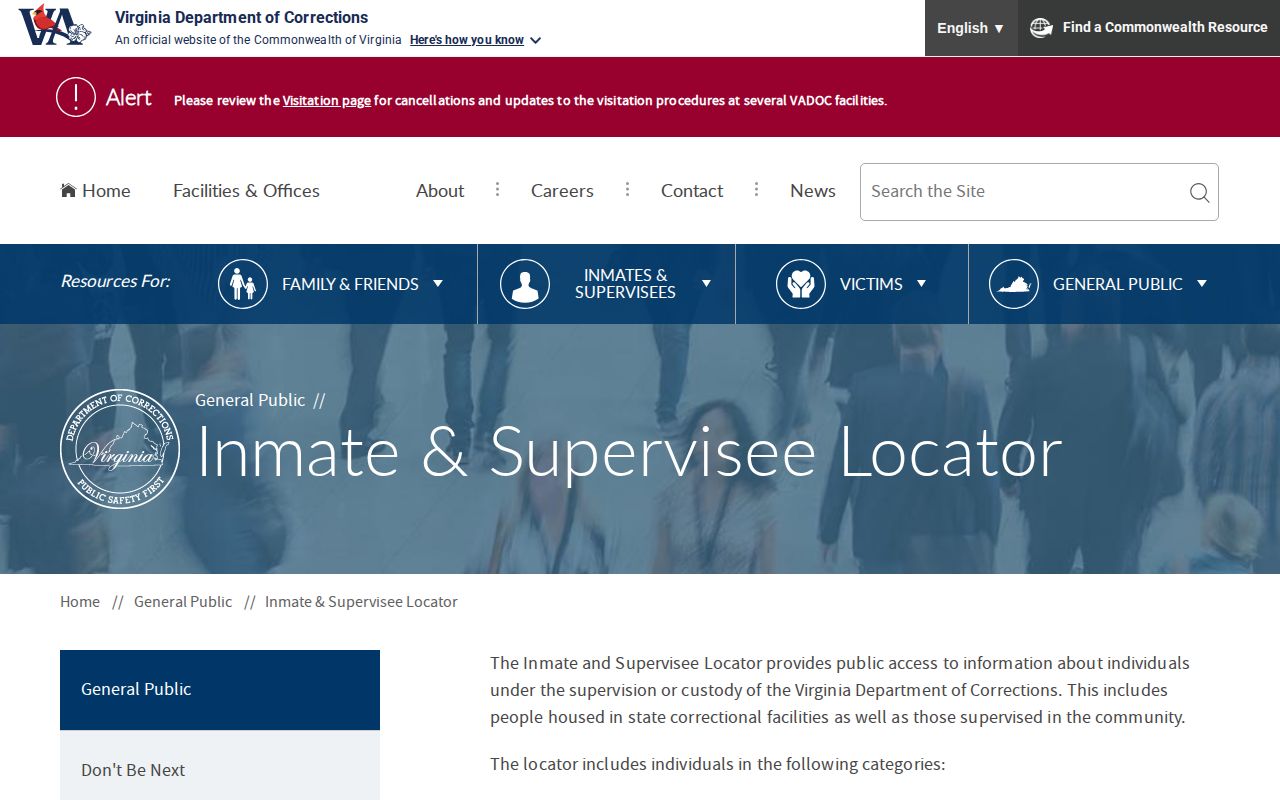
The captured locator shows the statewide entry point. Its current-custody and supervision scope is not a complete archive of every past discharge.
A locator result must also be read by status. An institutional location means the person remains in VADOC custody. A District 16 or other probation and parole location can support release from prison into community supervision, but it does not establish final discharge from the sentence. No result is weaker still. The locator describes current custody and supervision rather than promising a full historical archive. For a person who has completed supervision, request VADOC records or check the Parole Board's annual discharge material. For a person who never entered VADOC, return to NRVRJ and the Bland sentencing court instead of forcing a local jail term into the state search.
Note: Start with few filters, because spelling, compound names, or optional demographic fields can hide the correct VADOC result.
Virginia Credits Shape Bland Release Dates
Virginia does not use one simple rule that every prisoner serves 85 percent. VADOC separates Good Conduct Allowance, or GCA, from Earned Sentence Credits, or ESC. GCA generally concerns felony offenses before January 1, 1995 and certain older misdemeanor cases. Its classifications can allow from zero through 30 good days for each 30 days served. ESC generally applies to felony offenses on or after that date, but the rate still depends on the offense category, classification, and current exclusions.
Under the current framework, specified ESC-1 categories can earn from zero to 4.5 days per 30 days served. Qualifying ESC-2 categories can earn from zero to 15 days per 30. The maximum 4.5-day rate works out to about 86.96 percent served in a 34.5-day adjusted block. That is why an 85-percent shortcut is not exact and cannot be applied to each sentence. Virginia Code §53.1-202.3 supplies the offense and rate rules. It also states that earned credits do not cut the time needed before parole eligibility.
Section 53.1-202.2 defines earned sentence credits, while §53.1-202.4 addresses earning and forfeiture criteria. The statutes must be read with the sentence, offense date, and official calculation. A web estimate cannot replace that computation.
The VADOC time-computation source explains both credit systems and the factors applied by corrections staff.
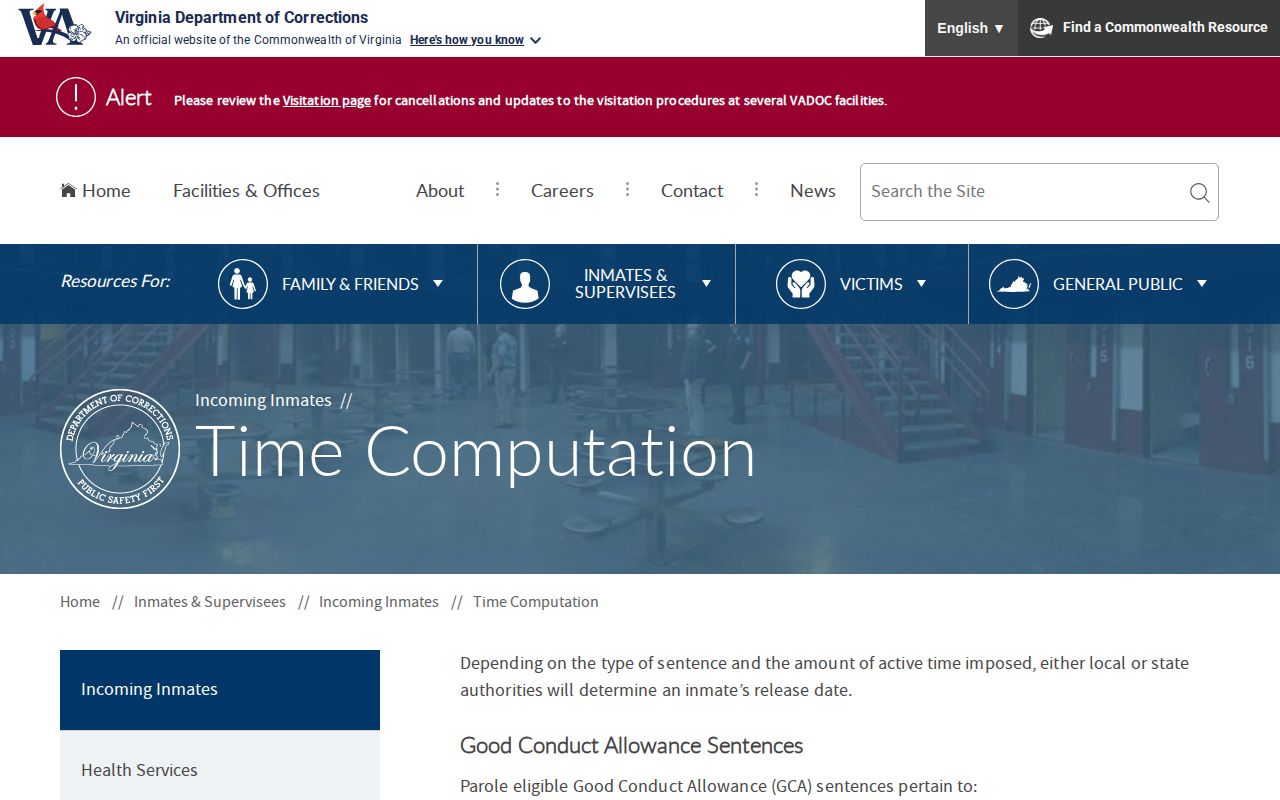
This official overview is the safer reference for the governing system; it does not calculate a date for a person without the full sentence record.
Bland County Sentence Calculation Inputs
A court order may state an active term that looks longer than the projected date in VADOC. The records need not conflict. The court imposes the sentence. The time calculator then applies pre-sentence jail credit, the proper GCA or ESC system, consecutive or concurrent structure, and later events. Active time is the part to be served. Suspended time remains subject to the order but is not the same as the current active term.
VADOC describes state computation for applicable active sentences over 12 months and a division of responsibility for other sentence types and lengths. That makes the state locator a poor universal calculator for a short NRVRJ term. For a local sentence, obtain the NRVRJ computation or release record and the Bland sentencing order. No published NRVRJ weekend-release rule or local good-time policy was found. A Friday adjustment must not be assumed.
When a date seems wrong, gather the sentencing and amended orders, proof of jail credit, DOC number, locator date, and any calculation letter. Send a focused correction request to the VADOC Court and Legal or Correspondence Unit for a state sentence. Ask NRVRJ and the court about a local term. The question should identify the exact input thought to be missing rather than ask an unrelated office to create a new calculation.
Why Bland Release Dates Change
A projected date is current only at the time of inquiry. New legal or correctional information can change the inputs. A later date does not by itself prove an error. An earlier date does not prove that the person will exit to the community. The reason must be tied to the proper order, credit record, or receiving agency.
| Factor | Possible effect | Record to check |
|---|---|---|
| Jail credit | Verified pre-sentence days can change time remaining | Sentencing order and computation record |
| Credit class or forfeiture | Earning rate, loss, or restoration can move a good-time date | VADOC time-computation record |
| Consecutive or concurrent terms | Sentence structure changes the combined calculation | Final and amended court orders |
| Court modification | An amended active term can change the projection | Signed amended order |
| Parole action | A grant begins a later VADOC release process | Board report and later release papers |
| Detainer or hold | Another agency may receive the person at the end of one stay | Release destination and receiving-agency record |
A Parole Board grant is often misunderstood. The Board action records the decision, not the prison gate event. VADOC later sets the release date under the governing law and prepares conditions. A detainer can also mean the person leaves one facility but remains in custody elsewhere.
Note: A maximum expiration date may differ from physical exit when lawful conditional release begins before the sentence's final end point.
Two Bland County Release-Date Systems
Bland County combines an unusual pair of systems. The regional jail that serves local arrests is outside the county, while the state prison named for Bland is inside it. A search for a “Bland inmate” can therefore point to the wrong authority. NRVRJ records a regional-jail stay. Bland Correctional Center holds state prisoners from across Virginia under VADOC.
For NRVRJ, search the official jail lookup with “Include released inmates.” A populated Release Date is direct evidence that the listed jail stay ended, but it is not a projected sentence field and does not state the destination. Call the jail or request the underlying release record for the type and receiving agency. For a VADOC prisoner, use the locator, official projected fields, and release packet. A move from Bland Correctional Center to another prison is a transfer, not release.
This split also affects notifications. Local VINE registration does not transfer into VADOC's separate NAAVI system after a state-custody move. A status alert may flag an event, but the official computation and release papers control the date. The right chain depends on custody, not on the county name alone.
A third custodian may also enter the chain. The end of an NRVRJ booking can mean transfer to VADOC, another jail, a federal authority, or immigration custody. Likewise, a VADOC release date may lead to another lawful detainer rather than a community exit. Ask for the releasing authority and destination when that distinction matters. The date proves only the event described by its source.
Confirm a Bland County Release Date
Use the record closest to the event. A state-prison notification-of-release letter precedes the date. At release, VADOC reads the applicable Order of Release or conditions, obtains signatures, returns documented property, and records the action. VADOC says an eligible person is released by 11:59 p.m. on the date, weather permitting. That statewide rule applies to VADOC facilities, not to NRVRJ. The regional jail publishes no release hour or weekend protocol.
The official VADOC facility-release process identifies the papers, funds, property, transport, and detainer distinctions.
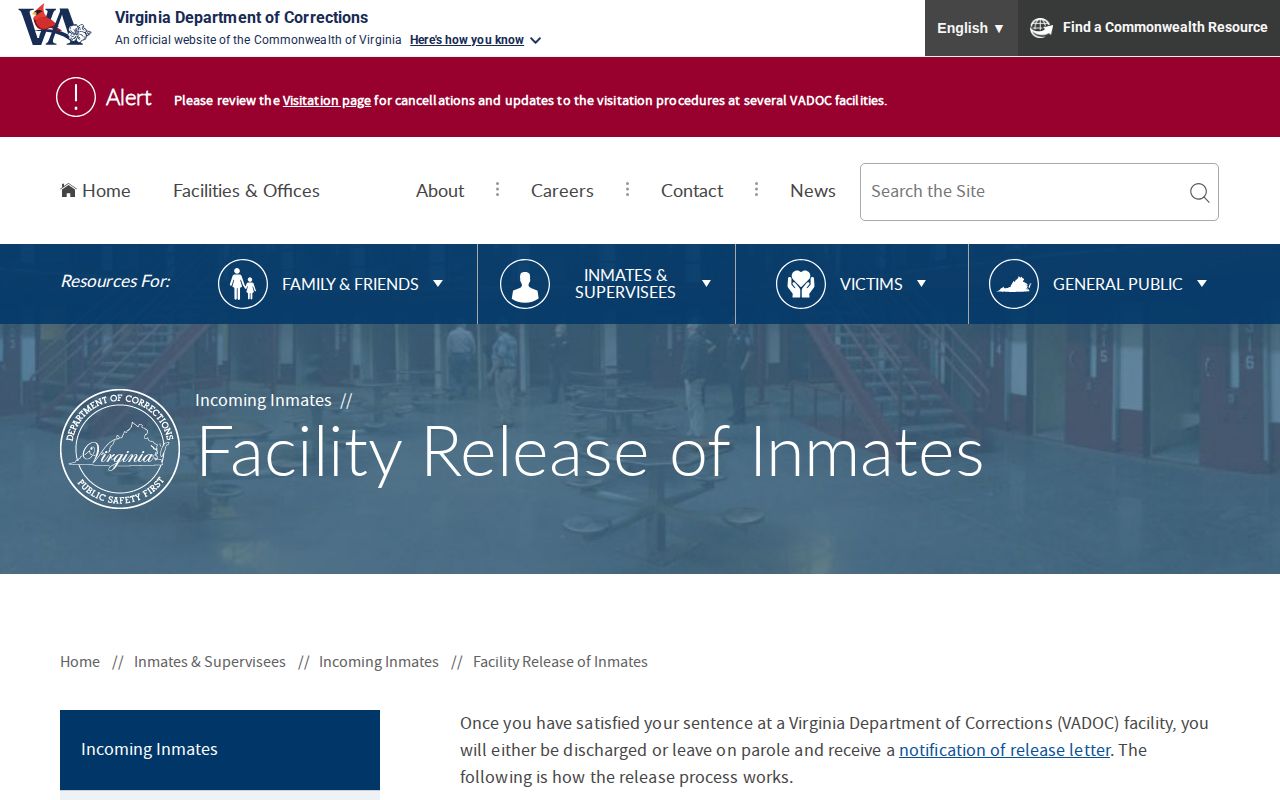
The captured guidance shows why a signed release record is stronger evidence of physical exit than a date viewed earlier in a locator.
For an NRVRJ date, call 540-643-2000 when the timing or destination matters. For VADOC, compare the locator with the release letter and signed papers. The VINELink Release Check can help track a local custody event, while NAAVI serves state custody and is not connected to local VINE. Neither service replaces direct confirmation.
Finally, label each date. Projected parole eligibility, good-time release, mandatory parole, maximum expiration, physical release, and supervision discharge occur at different stages. A clear label prevents a forecast, a Board decision, or the end of supervision from being mistaken for the day the person left custody.
If two official records differ, note when each was issued and ask the agency that performs the computation. A newer amended order or restored credit may explain the change. Preserve the official field names in any request for correction.